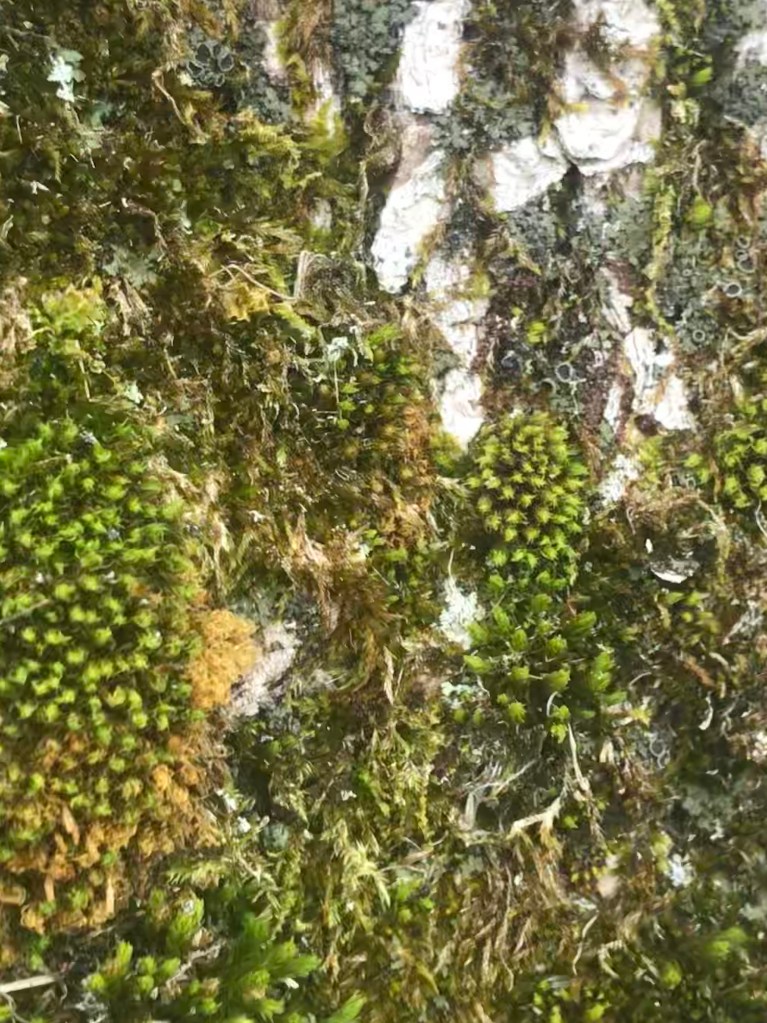
Walking around campus, it was interesting to get closer to the surroundings that I walk past everyday. Even though I walk pack the environment and objects in these pictures at least once a day, I was able to see my surroundings from a different perspective. I was trying to achieve getting close enough to the subject that the overall item of interest remained unknown, while still delivery the sensory principle that was sticking out to me. I picked this moss on the tree because of how many variations of colors the trunk obtained. I see various hues of green, brown, white, gray, and yellow.

Unlike some of my other pictures, this one immediately stuck out to me as a good example of using the shape sensory principle. Almost instantly, the white shapes jumped out at me as clouds in the sky. The contrast of the black background with impurities highlights the white figures. In reality, this is a zoomed up picture of the bottom of a light post that has paint chipping off.

This image is one of the more recognizable, but the viewer is surrounded by repeated lines while looking at the picture. I helped solve my problem of knowing too much about the subject of this photo by cropping the image. The texture of each strand intensifies the depth and seems as though these lines could go on forever. I imagine being in the middle of a cornfield while looking at this.

While looking through my photos, trying to find the one that best portrayed relative size, I had an AHA moment with this one. At first this was not one of my favorites, but then I realized that the zoomed up leaf looks relatively large in comparison to the reflection of my head and body in the puddle. It seems as though if the camera were to back up the leaf and figure would be the same size. I also appreciate the color and texture in the background, made by the pavement.
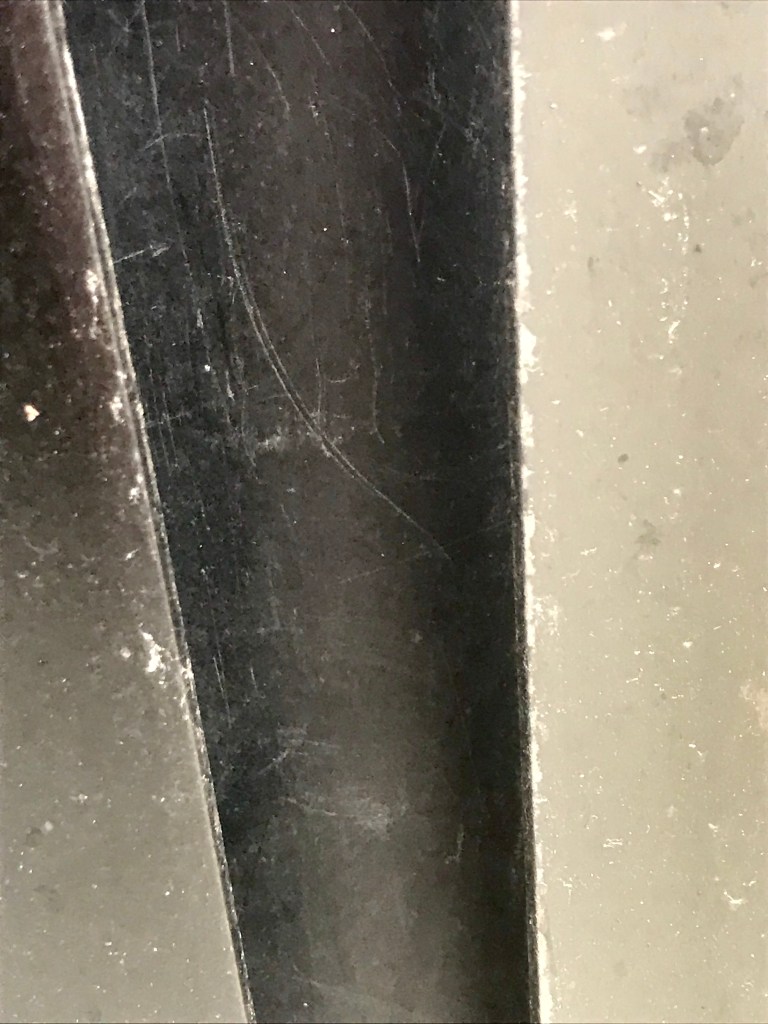
Lastly, division of space was demonstrated through the design of an outdoor trashcan. The structure of the trashcan has protruding bars that form around the body of the can. The outside layers of bars provide shade for the background can, which creates a difference in the saturation of the color black.
 Lily-Rose's Blog
Hi LilyRose, Remember that relative size is supposed to be two objects of the same shape that are different in size. The difference is size causes the brain to infer that one of the objects is a farther distance away from the viewer.
LikeLike
PASS- Nice work finding sensory photos–the last photo should be labeled division of space. Note: Relative Size is incorrect.It is when two identical shapes differ only in size, this relative size is the depth cue that allows us to estimate the distance between the objects. By comparing the size of one object relative to another similar shaped object, we can perceive that some objects are closer or farther away.
https://monoculardepthcues.fandom.com/wiki/Relative_Size
LikeLike